
Reports, articles, testimony, and translations.
A filterable archive of published work by Gregory C. Allen on AI policy, U.S.–China competition, semiconductor export controls, and defense tech. Filter by type or topic, or search inline. Reverse-chronological within each filter.
Looking for a guided read? Start with the topic guides: AI, Semiconductors, and Defense Tech.
Interested in commissioning custom research? Use our contact form →
Selected work
A curated set of reports and analysis flagged as the most consequential. The full archive is below.
Understanding U.S. Allies’ Current Legal Authority to Implement AI and Semiconductor Export Controls
DeepSeek, Huawei, Export Controls, and the Future of the U.S.-China AI Race
The United Arab Emirates’ AI Ambitions
The True Impact of Allied Export Controls on the U.S. and Chinese Semiconductor Manufacturing Equipment Industries
The AI Safety Institute International Network: Next Steps and Recommendations
Why Is the U.S. Defense Industrial Base So Isolated from the U.S. Economy?
The Department of Defense’s Collaborative Combat Aircraft Program: Good News, Bad News, and Unanswered Questions
Mapping the Semiconductor Supply Chain: The Critical Role of the Indo-Pacific Region
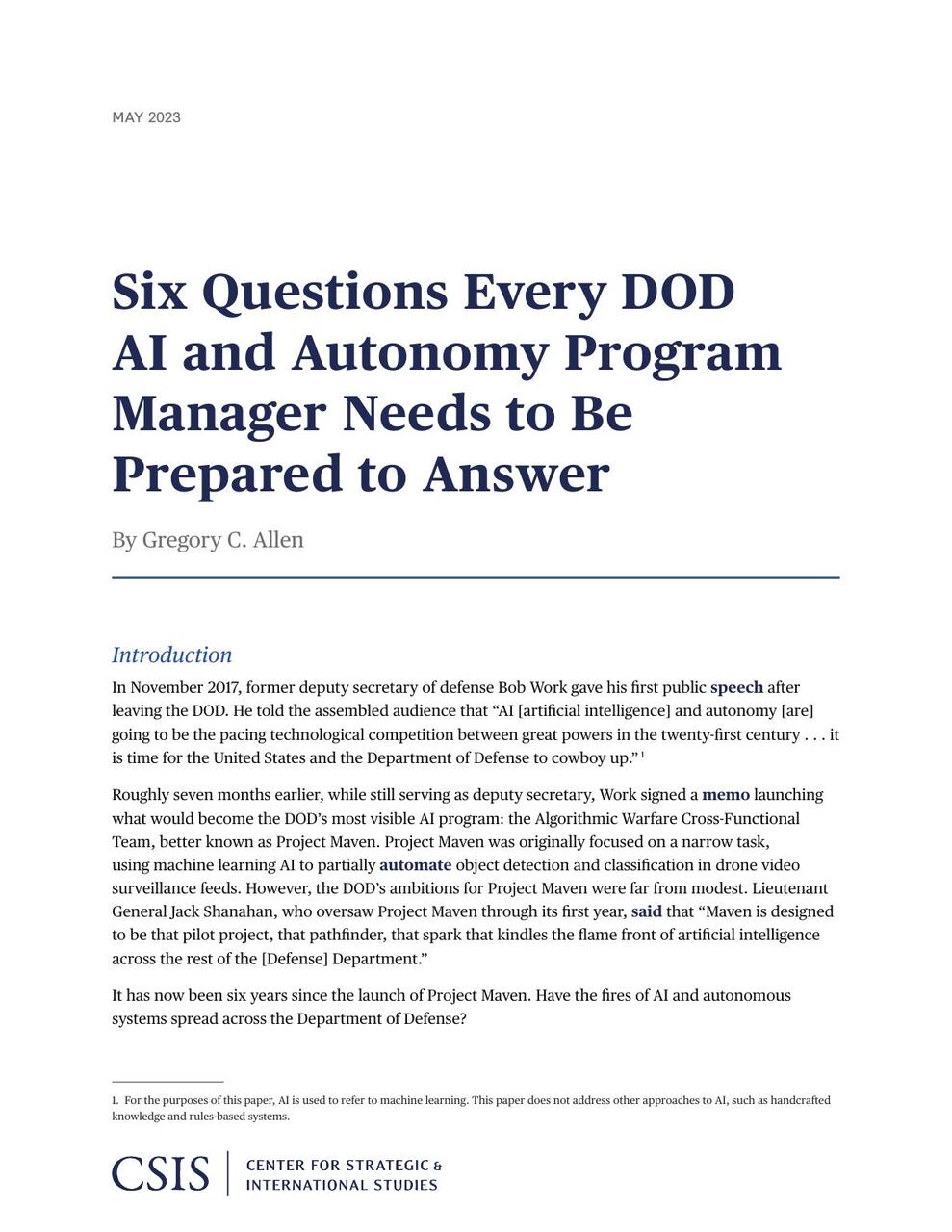
Six Questions Every DOD AI and Autonomy Program Manager Needs to Be Prepared to Answer
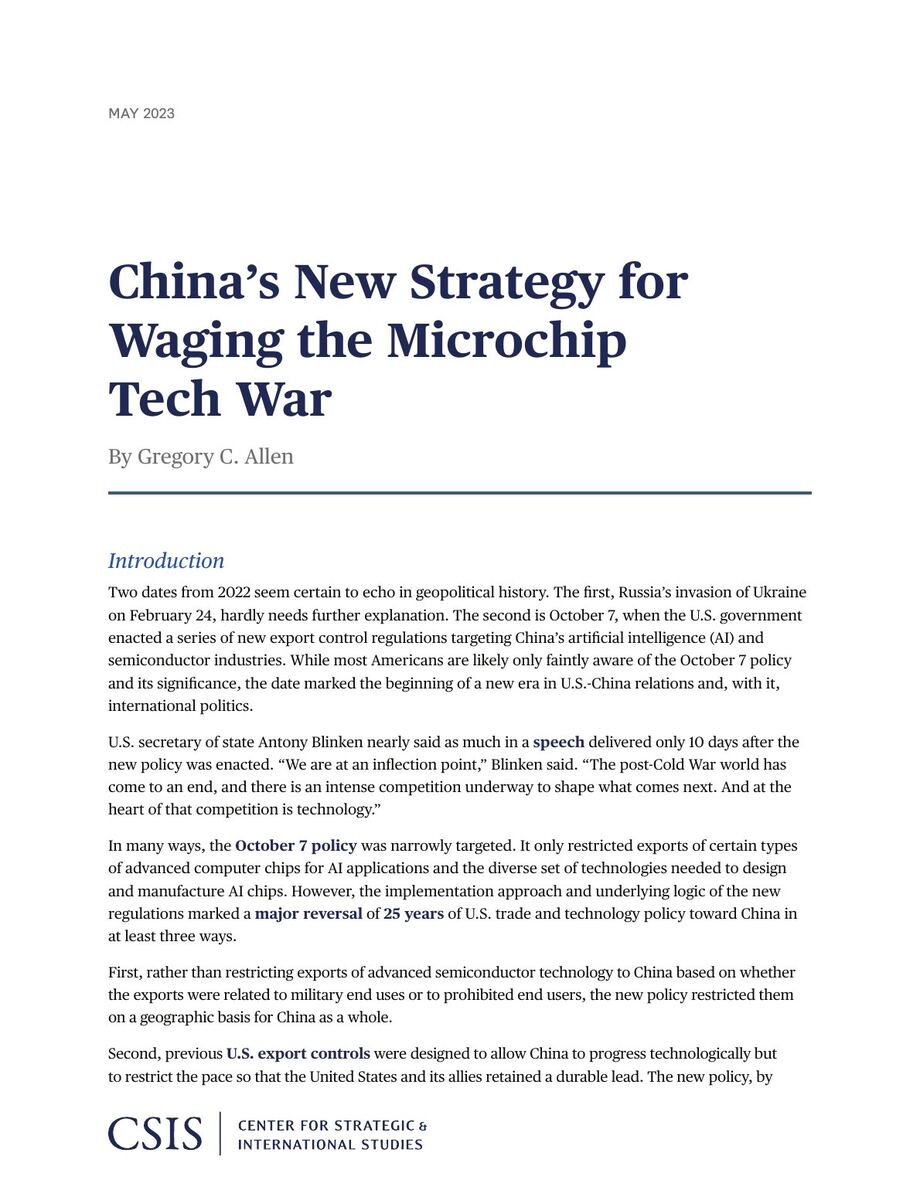
China’s New Strategy for Waging the Microchip Tech War
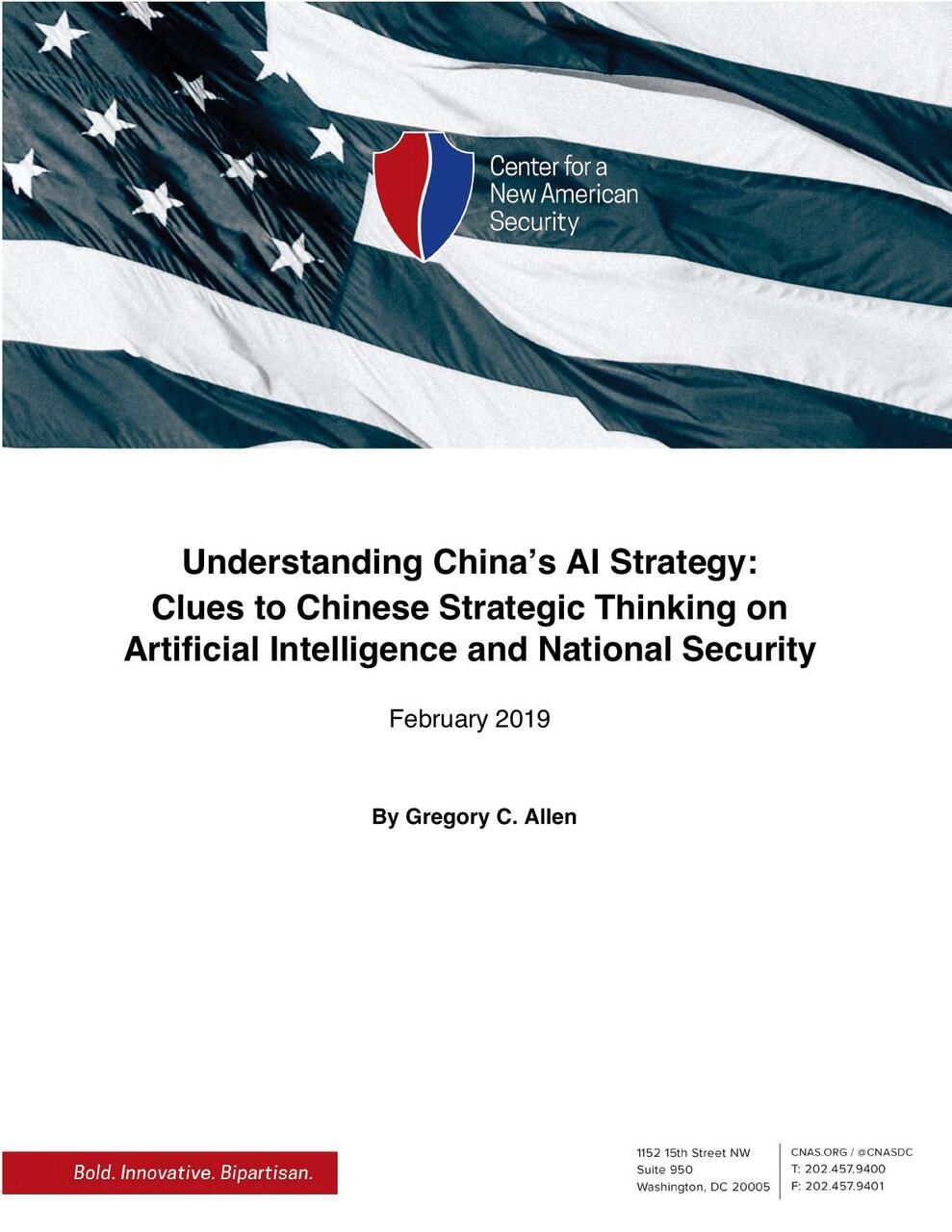
Understanding China’s AI Strategy: Clues to Chinese Strategic Thinking on Artificial Intelligence and National Security
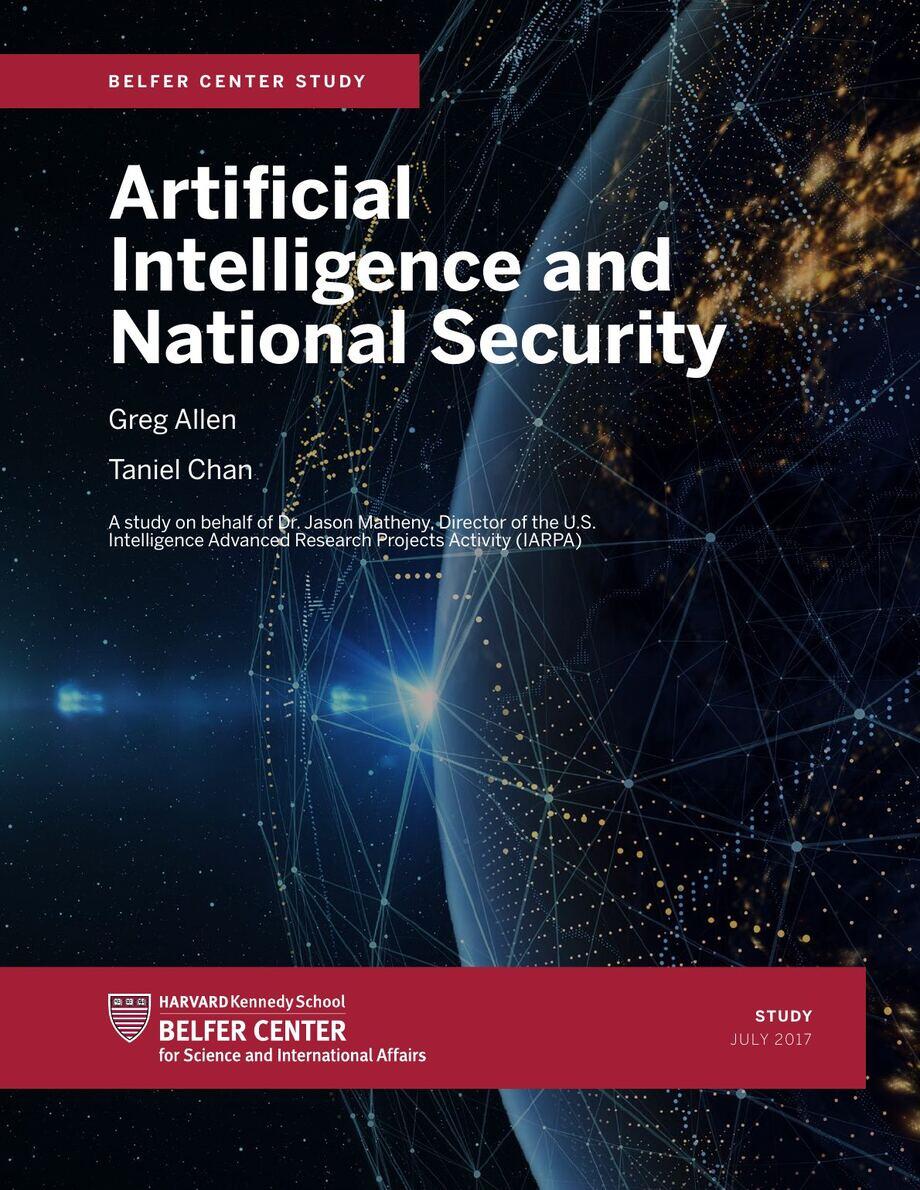
Artificial Intelligence and National Security
Full archive
55 itemsThe Insurance Industry’s Retreat from AI Threatens to Slow Innovation and Adoption
In a new paper, Gregory C. Allen proposes four policy interventions that can help the United States develop a robust AI insurance market that sees insurance as an accelerator, not a brake, on AI adoption.
What Is Maven Smart System and What Does It Do?
This Critical Questions piece provides a detailed overview of Maven Smart System, the Palantir-built AI-powered software platform that has enabled a revolution in military targeting. It examines how MSS works, the problems it addresses, its use of large language models via Anthropic, and its role as a core component of the Pentagon’s push for Combined Joint All-Domain Command and Control.
China’s Challenge to American AI Leadership
This congressional testimony before the U.S. Senate Foreign Relations Subcommittee on East Asia, the Pacific, and International Cybersecurity Policy examines China’s challenge to American leadership in artificial intelligence. It outlines the strategic, industrial, and policy choices facing the United States in the U.S.–China AI competition.
Opportunities to Strengthen U.S. Biosecurity from AI-Enabled Bioterrorism: What Policymakers Should Know
This report examines how advances in artificial intelligence are reshaping biosecurity threats and the bioterrorism risk landscape. It identifies concrete steps the U.S. government and industry can take to strengthen biosecurity defenses against AI-enabled bioweapon development.

DeepSeek: A Deep Dive
This congressional testimony before the U.S. House Committee on Science, Space, and Technology examines DeepSeek’s release and what it reveals about the U.S.–China AI race. It analyzes DeepSeek’s actual hardware footprint and the implications for U.S. semiconductor export-control policy.
Understanding U.S. Allies’ Current Legal Authority to Implement AI and Semiconductor Export Controls
This report examines the legal tools and policy frameworks shaping U.S. allies’ export controls on AI and semiconductor technologies. It analyzes the challenges of aligning allied authorities with U.S. national-security requirements and the gaps that remain in multilateral coverage.
DeepSeek, Huawei, Export Controls, and the Future of the U.S.-China AI Race
This report examines DeepSeek’s origins, achievements, and geopolitical impact, with implications for AI and semiconductor export controls. It explores the policy challenges posed to U.S. policymakers by an evolving U.S.–China AI race in which Chinese frontier-model capabilities have advanced faster than expected.
CSIS Translation: January 2025 Updated Japanese Export Controls on High-Performance Semiconductor Manufacturing Equipment
This CSIS-commissioned English translation makes available Japan’s January 2025 updated export controls on high-performance semiconductors and manufacturing equipment. It provides primary-source access for U.S. and English-language policy audiences.
CSIS Translation: Updated Dutch Export Controls on Semiconductor Manufacturing Equipment
This CSIS-commissioned English translation makes available the Netherlands’ updated export controls on semiconductor manufacturing equipment. It provides primary-source access for U.S. and English-language policy debate.
The United Arab Emirates’ AI Ambitions
This report examines the United Arab Emirates’ emergence as a regional AI hub and its strategic technology relationships with both U.S. and Chinese partners. It analyzes the geopolitical implications of UAE–China AI cooperation and the policy choices facing U.S. export-control authorities.
Updating Augustine’s Law: Fighter Aircraft Cost Growth in the Age of AI and Autonomy
This article updates Augustine’s Law — the long-running observation that fighter aircraft costs grow exponentially over time — for the era of AI and autonomy. It examines what AI-enabled airpower implies for future Pentagon procurement budgets.
Understanding the Biden Administration’s Updated Export Controls
This report explains the Biden administration’s December 2024 expansion of semiconductor export controls on China, including new restrictions on chip-manufacturing equipment and high-bandwidth memory. It assesses the rationale, the international response, and the policy challenges left for the incoming administration.
The True Impact of Allied Export Controls on the U.S. and Chinese Semiconductor Manufacturing Equipment Industries
This report quantifies the actual economic and technological impact of multilateral semiconductor export controls on both U.S. and Chinese chip industries. It draws on company financial data and revenue analysis to assess whether the controls are achieving their stated national-security objectives.
The AI Safety Institute International Network: Next Steps and Recommendations
This report analyzes the international network of AI Safety Institutes that emerged following the Bletchley Park, Seoul, and San Francisco AI Safety Summits. It offers recommendations for next steps in cross-border safety research coordination, evaluation standards, and institutional design.
The Biden Administration’s National Security Memorandum on AI Explained
This Critical Questions piece explains the National Security Memorandum on AI issued by the Biden administration in October 2024. It identifies the memorandum’s primary audience, main objectives, and implications for federal AI implementation.
Mismatch of Strategy and Budgets in AI Chip Export Controls
This article identifies a structural mismatch between U.S. strategy on AI chip export controls and the budgetary resources required to enforce them. It argues that funding for the Bureau of Industry and Security is insufficient for the policy goals being pursued.
Why Is the U.S. Defense Industrial Base So Isolated from the U.S. Economy?
This article asks why the U.S. defense industrial base is so isolated from the broader U.S. economy and what the consequences are for innovation, scale, and resilience. It identifies the structural and policy factors driving the isolation.
The Department of Defense’s Collaborative Combat Aircraft Program: Good News, Bad News, and Unanswered Questions
This report examines the U.S. Department of Defense’s Collaborative Combat Aircraft program — uncrewed autonomous aircraft designed to fly alongside crewed fighters. It assesses program progress, contracting structure, doctrinal questions, and unanswered issues around scaling and acquisition.
The AI Seoul Summit
This Critical Questions piece breaks down the policy outcomes of the May 2024 AI Seoul Summit, the second international AI safety summit. It assesses the summit’s commitments and the trajectory of the international AI governance architecture.
Advancing the Hiroshima AI Process Code of Conduct under the 2024 Italian G7 Presidency: Timeline and Recommendations
This report analyzes the Hiroshima AI Process Code of Conduct adopted by the G7 in 2023 and its evolution under Italy’s 2024 G7 presidency. It identifies the policy gaps the Code addresses and the implementation challenges facing G7 governments and companies.
Advancing the G7’s Relationship with Africa through AI
This article examines how the G7 can deepen its relationship with African partners on AI and emerging technologies. It identifies opportunities under the 2024 Italian G7 presidency for AI partnerships across the African continent.
2024 AI Policy Forecast
This report forecasts the major AI policy developments expected in 2024 across the United States, allied governments, and China. It identifies the inflection points and strategic dynamics likely to shape the year’s AI governance landscape.
Technology Will Remain the Heart of U.S.-China Competition in 2024
This article forecasts that technology — and AI in particular — will remain the central arena of U.S.–China competition in 2024. It identifies the key technology-policy questions facing the U.S. government in the year ahead.
U.S. Senate AI Insight Forum - National Security - Written Statement
This written statement was delivered to the U.S. Senate AI Insight Forum on national security, organized by Senate Majority Leader Chuck Schumer. It addresses the national-security implications of artificial intelligence for U.S. defense and intelligence.
In Chip Race, China Gives Huawei the Steering Wheel: Huawei’s New Smartphone and the Future of Semiconductor Export Controls
This report analyzes Huawei’s resurgence in the Chinese semiconductor industry following the launch of the Mate 60 smartphone with a 7-nanometer chip. It assesses what Huawei’s central role reveals about China’s strategy for circumventing U.S. export controls.
The Post-October 7 World: International Perspectives on Semiconductors and Geopolitics
This report examines how the October 7, 2022 expansion of U.S. semiconductor export controls reshaped the global semiconductor industry. It synthesizes international perspectives on the new export-control regime and its enduring geopolitical consequences.
Congressional Testimony - Advanced Technology: Examining Threats to National Security
This congressional testimony examines threats to U.S. national security posed by advanced technologies, including artificial intelligence and semiconductor manufacturing. It outlines policy recommendations for the U.S. government to maintain its technology lead.
A New National Security Instrument: The Executive Order on Outbound Investment
This article analyzes President Biden’s August 2023 Executive Order on Outbound Investment, which establishes restrictions on U.S. investment in Chinese AI, semiconductor, and quantum companies. It assesses the order as a new national-security policy instrument.
Blocking China’s Access to AI Chips Matters to U.S. National Security
This article argues that blocking China’s access to advanced AI chips is a matter of fundamental U.S. national-security importance. It explains why semiconductor export controls are central to maintaining U.S. military and economic advantage.
CSIS Translation: Updated Dutch Export Controls on Semiconductor Manufacturing Equipment and Related Government Documents
This CSIS-commissioned English translation makes available the Netherlands’ 2023 export controls on semiconductor manufacturing equipment — the country’s first dedicated controls, adopted in the wake of the U.S. October 7, 2022 measures. It provides primary-source access to the policy text for U.S. and English-language audiences.
China Is Striking Back in the Tech War With the U.S.
This TIME magazine op-ed analyzes China’s response to U.S. semiconductor export controls, including new restrictions on gallium and germanium exports. It assesses the prospects for an extended period of mutual technology controls between the two powers.
CSIS Translation: Updated Japanese Export Controls on High-Performance Semiconductor Manufacturing Equipment
This CSIS-commissioned English translation makes available Japan’s 2023 export controls on high-performance semiconductors — the first round of Japan’s dedicated controls, later revised in January 2025. It provides primary-source access for U.S. and English-language policy audiences.
Mapping the Semiconductor Supply Chain: The Critical Role of the Indo-Pacific Region
This report maps the global semiconductor supply chain and the critical role of the Indo-Pacific region in advanced chip manufacturing. It identifies key chokepoints, dependencies, and policy implications for U.S. national security.
Six Questions Every DOD AI and Autonomy Program Manager Needs to Be Prepared to Answer
This report poses six questions that every U.S. Department of Defense AI and autonomy program manager should be prepared to answer. It draws on direct operational experience to identify the most common pitfalls in DoD AI program design, contracting, and execution.
China’s New Strategy for Waging the Microchip Tech War
This report analyzes China’s evolving strategy for the U.S.–China semiconductor competition, including its responses to U.S. and allied export controls. It assesses the prospects for Chinese chip self-sufficiency and the policy implications for the United States.
Advancing Cooperative AI Governance at the 2023 G7 Summit
This report analyzes the AI governance agenda at the 2023 G7 Summit in Hiroshima and the launch of the Hiroshima AI Process. It offers recommendations for advancing cooperative international AI governance among the G7 partners.
Congressional Testimony - U.S. China Economic and Security Review Commission
This congressional testimony before the U.S.–China Economic and Security Review Commission examines China’s pursuit of defense technologies. It addresses implications for U.S. and multilateral export-control and investment-screening regimes.
Japan and the Netherlands Announce Plans for New Export Controls on Semiconductor Equipment
This article analyzes the announcements by Japan and the Netherlands of new semiconductor export controls aligned with U.S. policy. It assesses the significance of allied harmonization for the multilateral export-control regime.
Clues to the U.S.-Dutch-Japanese Semiconductor Export Control Deal Are Hiding in Plain Sight
This report identifies clues in publicly available information about the trilateral U.S.–Dutch–Japanese semiconductor export-control agreement. It explains the policy logic behind the deal and what its terms reveal about allied cooperation on chip controls.
In Tech War with China, Biden Knows It’s Good to Have Friends
This TIME magazine op-ed argues that the Biden administration’s success in extending semiconductor export controls to Japan and the Netherlands shows the value of allied cooperation. It examines what the deal reveals about U.S. tech-policy strategy.
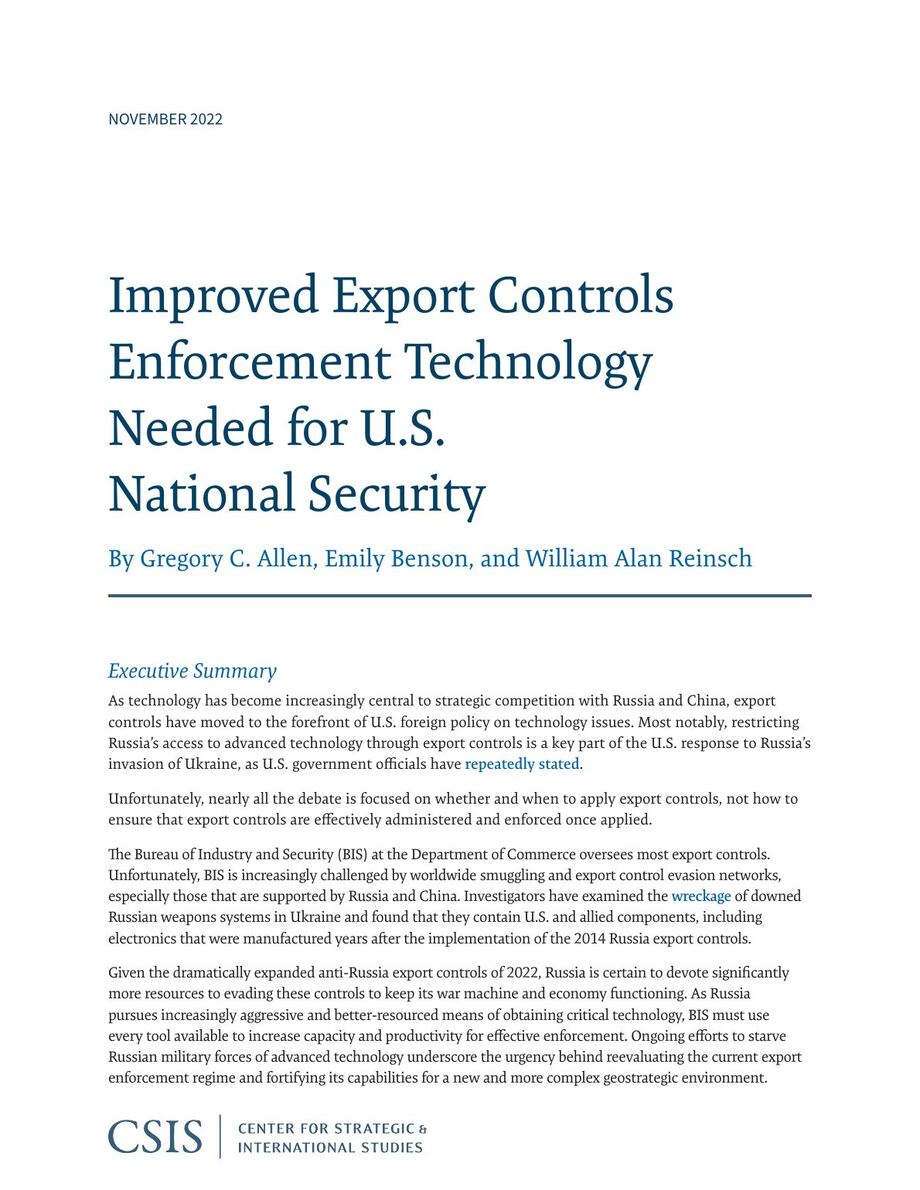
Improved Export Controls Enforcement Technology Needed for U.S. National Security
This report argues that the U.S. export-control system requires significant new technology investment to enforce expanded restrictions effectively. It identifies the data-science and AI capabilities the Bureau of Industry and Security would need to deploy.
The Only Way the U.S. Can Win the Tech War with China
This TIME magazine op-ed argues that the United States can sustain its lead in semiconductor technology only by maintaining and expanding multilateral export controls. It frames the post–October 7 controls as the most consequential U.S. tech-policy move in years.
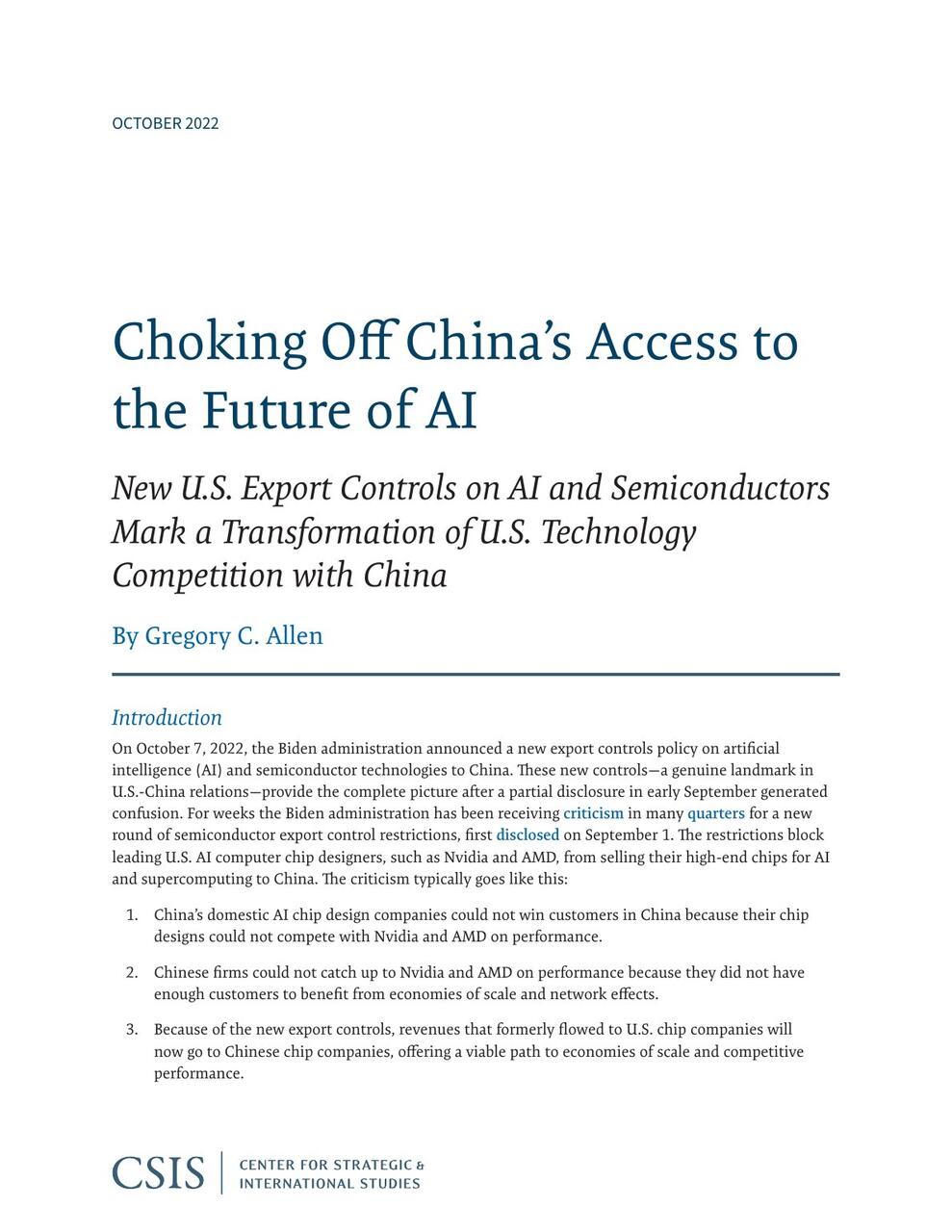
Choking Off China’s Access to the Future of AI
This report analyzes the U.S. Department of Commerce’s October 7, 2022 expansion of semiconductor export controls on China. It frames the controls as the most significant U.S. policy intervention into the U.S.–China technology competition since the start of the trade war.
DOD is updating its decade-old autonomous weapons policy. Confusion remains widespread about what it says.
This article examines the U.S. Department of Defense’s update of DoD Directive 3000.09, the policy framework governing autonomy in weapon systems. It clarifies widespread misconceptions about what the directive does and does not say.
Russia probably hasn’t used AI weapons in Ukraine yet, but that will likely change if the war drags on
This article argues that Russia has probably not yet deployed AI-enabled weapons in Ukraine, but that this is likely to change as the war drags on. It examines what near-term Russian AI deployment would mean for the global military AI landscape.
One Key Challenge for Diplomacy on AI: China’s Military Does Not Want to Talk
This article identifies a central obstacle to U.S.–China military AI diplomacy: China’s military reluctance to engage in formal dialogue. It examines the implications for crisis stability and arms control around AI weapons.
Across Drones, AI, and Space, Commercial Tech Is Flexing Military Muscle in Ukraine
This article documents how commercial drone, AI, and space technologies have flexed unexpected military muscle in the Russia–Ukraine war. It identifies the policy implications for U.S. defense industrial strategy and procurement.
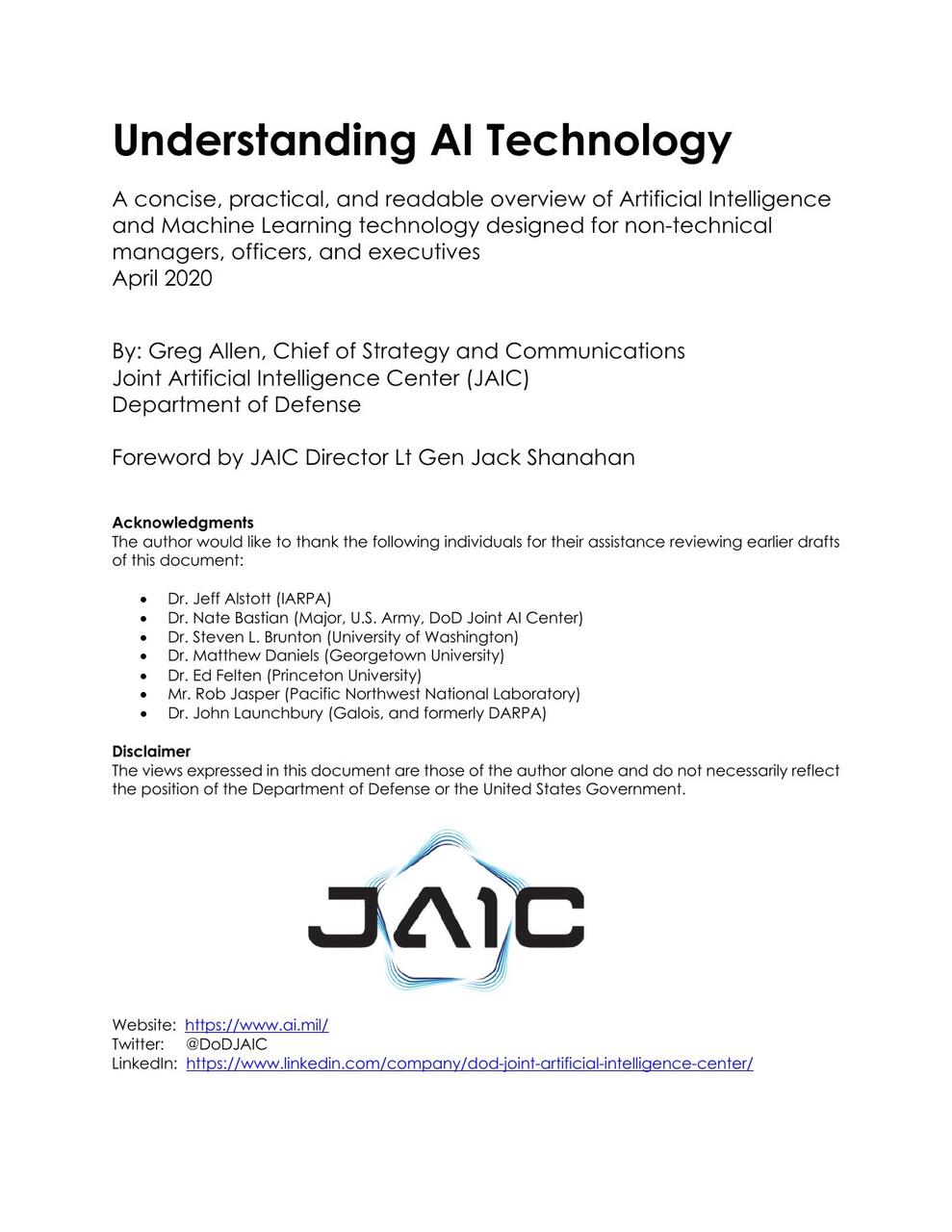
Understanding AI Technology: A concise, practical, and readable overview of Artificial Intelligence and Machine Learning technology designed for non-technical managers, officers, and executives
Published by the U.S. Department of Defense, this primer offers a concise, practical, and readable overview of artificial intelligence and machine learning technology. It is designed for non-technical managers, officers, and executives navigating AI policy and acquisition decisions.
Understanding China’s AI Strategy: Clues to Chinese Strategic Thinking on Artificial Intelligence and National Security
This foundational report examines clues to Chinese strategic thinking on artificial intelligence and national security. It draws on Chinese-language sources to characterize the strategic logic and policy ambitions behind Beijing’s AI program.
AI Researchers Should Help With Some Military Work
This Nature article argues that AI researchers have an ethical case for engaging with selected military applications. It draws on the Project Maven controversy to identify which kinds of military AI work merit researcher participation.
Project Maven brings AI to the fight against ISIS
This Bulletin of the Atomic Scientists piece examines the U.S. Department of Defense’s Project Maven, the Pentagon’s first major operational AI initiative. It describes the program’s goals and the broader implications of military AI for national security.
Artificial Intelligence and National Security
This early Belfer Center report frames artificial intelligence as a strategic national-security technology. It outlines the policy choices facing the U.S. government as AI emerges as a capability comparable to space, cyber, or nuclear technology.
AI Will Make Forging Anything Entirely Too Easy
This WIRED essay warns that advances in artificial intelligence will make digital forgery — of images, video, and audio — radically cheaper and more convincing. It identifies the policy and societal implications of the coming era of AI-enabled deception.
America’s plan for stopping cyberattacks is dangerously weak
This Vox essay argues that U.S. cyber-defense doctrine is dangerously underdeveloped relative to the threat. It identifies the policy gaps in deterrence, attribution, and response that leave the country exposed.
Thank Goodness Nukes Are So Expensive and Complicated
This WIRED essay argues that the high cost and technical complexity of nuclear weapons has been an underappreciated source of strategic stability. It examines the implications as advances in AI and computing potentially lower barriers to weapons of mass destruction.